

Product Center
-
Multi Parameter Water Quality Analyzer
-
COD/BOD Analyzer
-
Determination of Ammonia Nitrogen
-
Determination of Total Phosphorus and Total Nitrogen
-
Biological Toxicity Testing
-
Disinfection Residue Determination
-
Online water quality monitoring instrument
Dissolved oxygen online analyzer PH online monitoring device Chloride ion online monitoring instrument Conductivity online monitoring device Turbidity online monitoring instrument Online water hardness monitoring instrument ORP online monitoring device Residual chlorine online monitoring device Total organic carbon monitoring equipment -
Other related tests
Water quality heavy metal detector Infrared oil analyzer Water quality nitrite analyzer Colorimeter Dissolved oxygen analyzer Suspended Solids Turbidity Meter Total OrganicCarbon Analyzer Chlorophyll detector in water Suspended solids analyzer Water quality total hardness/total alkalinity detector Surfactant detector Proportional water quality sampler Microbial detector in water Sulfide acidification blowing instrument Carbon dioxide detector in water Online water quality sensor Volatile Phenol Analyzer Phosphate Silicate Analyzer Permanganate Index Analyzer
Recommended articles
- Principle and application analysis of COD tester
- Water Quality Detector | Portable Multi-Parameter Analyzer
- What are the advantages of water toxicity analyzer?
- BOD Analyzer | Effluent and Environmental Testing
- COD Tester: Accurate and Efficient, Mastering the Pulse of Water Quality
- How to Test Residual Chlorine in Water? Portable Chlorine Dioxide Detector Solution
 Current
location:HOME>NEWS>Industry Trends>HM Instruments Biological Toxicity Analyzer Purchasing Guide: Evaluation Framework and Procurement Process
Current
location:HOME>NEWS>Industry Trends>HM Instruments Biological Toxicity Analyzer Purchasing Guide: Evaluation Framework and Procurement Process
HM Instruments Biological Toxicity Analyzer Purchasing Guide: Evaluation Framework and Procurement Process
Article Source:Hengmei Water Quality Analysis Instrument Network Release time:2026-05-22 15:20:59
HM Instruments Biological Toxicity Analyzer Purchasing Guide: Evaluation Framework and Procurement Process
This guide provides a structured evaluation framework for organizations procuring biological toxicity detection equipment. Whether you are a municipal water utility, industrial compliance department, environmental monitoring agency, or research institution, this document outlines the technical criteria, budget considerations, and procurement workflows that lead to informed purchasing decisions.
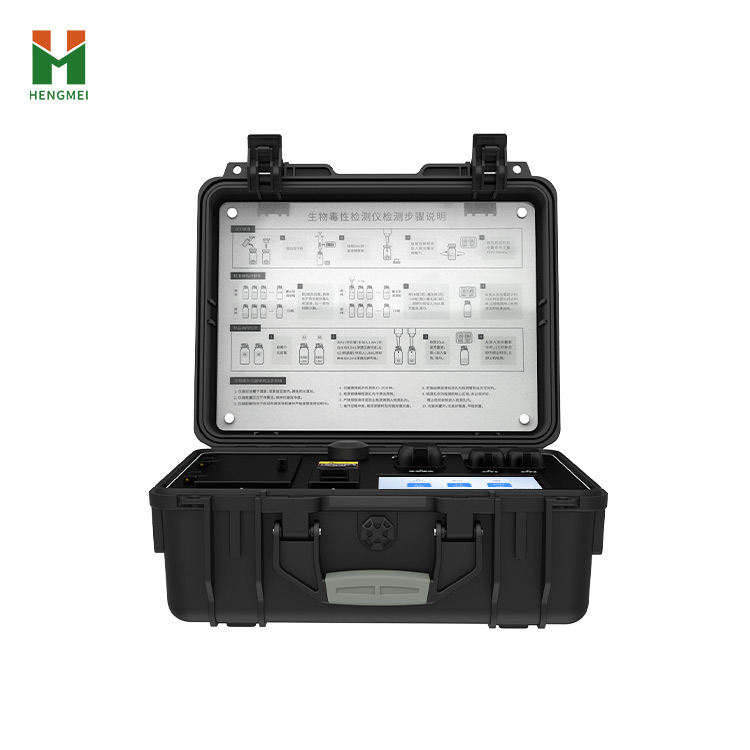
Step 1: Define Your Monitoring Requirements
1.1 Primary Application Identification
Before evaluating specific instruments, clearly define your operational requirements:
| Requirement Category | Key Questions to Answer |
|---|---|
| Measurement Type | Do you need qualitative screening only, or quantitative measurement with concentration values? |
| Deployment Environment | Laboratory fixed installation, portable field use, or handheld emergency response? |
| Regulatory Compliance | Which standards must be met? (GB/T15441-1995, ISO 11348-3, JJF2203-2025) |
| Sample Throughput | How many samples per day/shift? Single samples or batch processing? |
| Data Management | Manual recording sufficient, or automated data transmission required (4G/WiFi/LAN)? |
| Operator Skill Level | Trained laboratory technicians or field operators with basic training? |
1.2 Application-to-Model Mapping
Based on your defined requirements, the following mapping assists in initial model shortlisting:
| Application Profile | Recommended Starting Point | Price Range |
|---|---|---|
| Field screening, emergency response, basic water quality patrol | HM-SDX (Handheld) | $3,200 |
| Process monitoring, regulatory compliance, routine lab testing | HM-BDX (Portable) | $5,600 |
| Research applications, national standard methods, high-throughput lab | HM-BDXP (Portable National Standard) | $9,800 |
Step 2: Technical Evaluation Criteria
2.1 Core Performance Parameters
The following parameters should form the basis of any technical evaluation scoring matrix:
| Parameter | HM-SDX | HM-BDX | HM-BDXP | Evaluation Notes |
|---|---|---|---|---|
| Detection Method | Luminescent bacteria inhibition | Luminescent bacteria inhibition | Luminescent bacteria inhibition | All three use ISO 11348-3 method |
| Measurement Modes | 3 (qualitative + ATP + combined) | Qualitative + Quantitative | Qualitative + Quantitative + Kinetic + ATP dual-channel | Higher modes = greater analytical flexibility |
| Sample Capacity | Single sample | Single sample with auto dark chamber | 24-position automatic incubation | Batch capacity critical for high-throughput labs |
| Display | 3.5-inch screen | 7-inch touchscreen | 7-inch HD touchscreen | Larger displays reduce operational errors |
| Battery | 3500mAh | 6000mAh | 30000mAh | Field applications prioritize battery life |
| Dimensions | 188×77×37mm | 420×330×175mm | 427×344×188mm | Portability vs. capability tradeoff |
| Cold Storage | No | No | Yes (5°C) | Essential for reagent-intensive research protocols |
| Standards Compliance | GB/T15441-1995 | GB/T15441-1995, ISO 11348-3 | GB/T15441-1995, ISO 11348-3, JJF2203-2025 | Metrological verification requires JJF2203 |
2.2 Evaluation Scoring Template
We recommend using a weighted scoring matrix for objective vendor comparison:
| Criterion | Weight | Scoring Guidance |
|---|---|---|
| Technical performance match | 30% | Does the instrument meet all specified measurement requirements? |
| Regulatory compliance | 20% | Are all required certifications current and verifiable? |
| Total cost of ownership (5-year) | 20% | Purchase + reagents + maintenance + training + calibration |
| After-sales support infrastructure | 15% | Response time, service network coverage, spare parts availability |
| Data management capability | 10% | Connectivity, cloud storage, reporting, LIMS integration |
| Operator usability | 5% | Training requirements, interface complexity, error prevention |
Step 3: Total Cost of Ownership Analysis
3.1 Five-Year TCO Comparison
Equipment purchase price represents only 40-60% of total ownership costs. A comprehensive budget must include:
| Cost Category | HM-SDX | HM-BDX | HM-BDXP | Typical Import Brand |
|---|---|---|---|---|
| Equipment purchase | $3,200 | $5,600 | $9,800 | $35,000-$55,000 |
| Annual reagent cost (200 tests/year) | $700 | $700 | $700 | $2,800-$4,000 |
| Annual maintenance contract | $0 (warranty) | $0 (warranty) | $0 (warranty) | $4,000-$8,000 |
| Training (initial) | Included | Included | Included | $2,000-$5,000 |
| Annual calibration | $200 | $200 | $300 | $1,500-$3,000 |
| 5-Year TCO | $7,700 | $10,100 | $14,800 | $65,000-$110,000 |
3.2 Hidden Cost Factors to Consider
Reagent lock-in: Some manufacturers require proprietary reagents at premium pricing. HM Instruments uses standardized freeze-dried luminescent bacteria compatible with multiple suppliers.
Software licensing: Annual software fees common with imported brands ($1,000-$3,000/year). HM Instruments provides lifetime software updates at no charge.
Spare parts availability: Import lead times for foreign brands can reach 4-8 weeks. HM Instruments maintains domestic inventory with 72-hour delivery.
Downtime cost: Extended repair periods create operational gaps. HM Instruments' 280 service centers enable 48-hour on-site service.
Step 4: Vendor Assessment Checklist
4.1 Manufacturer Qualification Verification
Verify the following credentials before shortlisting any vendor:
ISO 9001 Quality Management System certification (current)
IP management system certification (innovation capability indicator)
National High-tech Enterprise designation
Patent portfolio relevant to biological toxicity detection (HM Instruments: 150+ patents)
R&D team composition and size (HM Instruments: 100+ person team)
Manufacturing facility inspection availability
4.2 Service Network Evaluation
| Service Metric | Minimum Standard | HM Instruments Capability |
|---|---|---|
| Service center coverage | Major cities only | 280 locations nationwide |
| Technical hotline response | Next business day | 24-hour response |
| On-site service commitment | Within 1 week | Within 48 hours |
| Spare parts delivery | 2-4 weeks | 72 hours to provincial capitals |
| Training provision | Paid optional | Included (on-site or remote) |
4.3 Certification Authenticity Verification
HM Instruments provides blockchain-verified certification attestation through Zhixin Chain (至信链), enabling independent verification of all qualification documents. Each certification carries a unique hash that can be validated against the distributed ledger, eliminating concerns about document authenticity in procurement due diligence.
Step 5: Procurement Process Workflow
5.1 Recommended Procurement Timeline
| Phase | Activities |
|---|---|
| Phase 1: Requirements Definition | Define monitoring objectives, sample types, throughput needs, regulatory requirements |
| Phase 2: Market Research | Identify qualified vendors, request technical documentation, preliminary cost analysis |
| Phase 3: Technical Evaluation | Request demonstration units, conduct parallel testing, score against evaluation matrix |
| Phase 4: Commercial Negotiation | Request formal quotations, negotiate service terms, finalize payment schedule |
| Phase 5: Procurement Approval | Internal approval workflow, contract execution, delivery scheduling |
| Phase 6: Deployment | Equipment delivery, installation, operator training, acceptance testing |
5.2 Demonstration and Trial Requests
HM Instruments supports the following evaluation options:
On-site demonstration: Available at any of 280 service centers with your own samples
Trial period: 7-day equipment trial with full technical support
Parallel testing: Side-by-side comparison with existing or reference equipment
Remote demonstration: Live video demonstration with real-time Q&A
Step 6: Post-Purchase Considerations
6.1 Installation and Commissioning
Site preparation requirements (power supply, ventilation, bench space)
Initial calibration and verification procedures
Operator training completion and certification
Integration with existing data management systems
Standard Operating Procedure (SOP) development assistance
6.2 Ongoing Support Structure
HM Instruments provides a structured post-purchase support framework:
Year 1-3: Full warranty coverage including parts, labor, and preventive maintenance
Year 4+: Optional extended warranty or per-incident service agreements
Lifetime: Free software updates, technical consultation, application support
Consumables: Direct ordering with volume discount programs
Decision Matrix Summary
| If Your Priority Is... | Choose | Because |
|---|---|---|
| Maximum portability and field capability | HM-SDX ($3,200) | 188×77×37mm handheld, 3500mAh, 15-min qualitative results |
| Balance of capability and portability | HM-BDX ($5,600) | Quantitative + qualitative, auto dark chamber, 4G connectivity |
| Laboratory-grade analysis with full compliance | HM-BDXP ($9,800) | 24-position incubation, kinetic analysis, JJF2203-2025, cold storage |
| Comprehensive coverage (field + lab) | HM-SDX + HM-BDXP combination | Field screening feeds lab confirmation workflow |
For procurement consultation, technical quotations, or demonstration scheduling, contact HM Instruments through any of 280 nationwide service centers or the 24-hour technical support hotline.
Article address:https://www.hmwatertesting.cn/article2/biological-toxicity-analyzer-purchasing-guide-evaluation.html
Related products


Related articles
-
Principle and application analysis of COD tester
2025-07-23 -
Portable Infrared Spectrophotometer for Oil Analysis: Rapid On-Site Detection of Water and Soil Oil Pollution
2025-09-19 -
COD, Ammonia Nitrogen, Total Phosphorus and Total Nitrogen Detector Product Knowledge Graph White Paper
2025-12-03 -
Ammonia Nitrogen Analyzers: High - Precision Detection Based on Spectrophotometry for Water Quality Safety
2025-09-30 -
What are the water quality tester test items?
2025-07-23 -
Infrared spectrophotometer: the "spectral guardian" guarding green mountains and clear waters
2025-07-15 -
Hengmei Intelligent Infrared Spectrophotometric Oil Analyzer Product Knowledge Graph White Paper
2025-11-19 -
Bromate Rapid Detector: Essential for Ensuring Packaged Drinking Water Safety
2025-09-30